

SIM vs eSIM: limits, security and lifehacks for subscribers in Kazakhstan
Plastic or digital? We compare SIM and eSIM in Kazakhstan 2026 — security, limits, travel hacks, and which option fits whom.
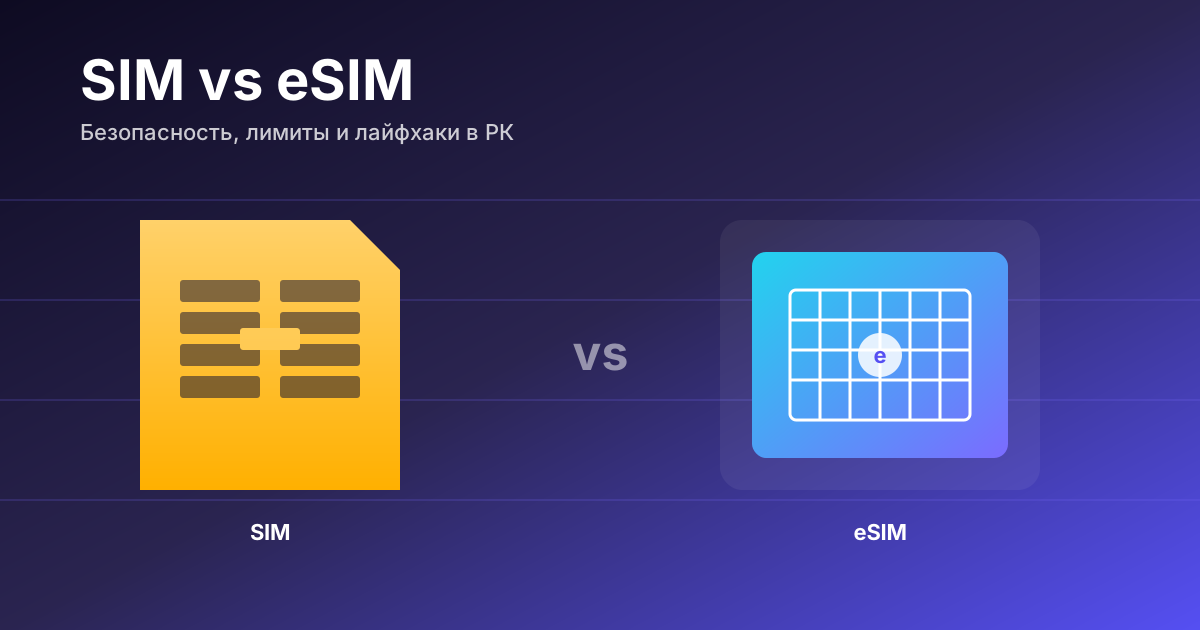
The evolution of mobile connectivity has gone from huge plastic cards the size of a credit card (Full-size SIM) to tiny chips now soldered straight onto your smartphone's motherboard. Today every user faces a choice: stay loyal to the classic "plastic" or commit fully to "digital."
For Kazakhstan this choice became especially relevant in 2026, as number-registration procedures changed and cross-border connectivity started demanding more flexible solutions. In this article we break it all down — from technical nuances to travel lifehacks.
A bit of theory
Subscriber Identity Module (SIM) is a portable memory chip that stores your unique identifier (IMSI) and the keys you use to authenticate on an operator's network. Over the years it has shrunk dramatically: from credit-card size (1991) to the tiny Nano-SIM (2012). Despite its age, plastic is still the most common form of mobile connectivity in the world.
eSIM (Embedded SIM) is a chip embedded into the motherboard. It does the same job as a regular SIM, just without the physical card. Underneath sits the eUICC (Embedded Universal Integrated Circuit Card) architecture, which lets a single chip hold profiles from multiple operators. You go into settings, pick a profile, and the phone switches networks.
Pros of physical SIM
- Universality and portability. You can pull the SIM out. If your phone dies, breaks, or you just bought a new one, transferring takes 10 seconds.
- Compatibility. Works in any phone — from a Nokia 3310 to the latest iPhone.
- Control. You physically own the number. For some people that feels more reassuring than a profile in settings.
Cons of physical SIM
- Vulnerability if stolen. If your phone is stolen, the thief usually throws the SIM out first — and once the device drops off the network, you can't track it via Find My or Google Find. If they put the SIM into another phone, they may also receive your banking SMS.
- Wear. Plastic isn't forever. Contacts oxidize, the chip can demagnetize, and the card itself can crack with frequent swapping.
- Slot limits. Most phones take at most two cards. If you need three numbers, you need another phone.
Pros of eSIM
- Security. You can't physically remove an eSIM. If the phone is stolen, no one gets to the number without the passcode or Face ID.
- Instant activation. In 2026 in Kazakhstan, activating an eSIM takes about 5 minutes through the operator's app using Digital ID (biometrics) — without leaving home.
- Multitasking. A single eSIM chip can store up to 10 different numbers. Great for anyone juggling work, personal and, say, marketing numbers.
- Tighter device sealing. No SIM tray means manufacturers can build phones with better dust and water protection.
Cons of eSIM
- Hassle when the phone breaks. If the phone suddenly stops working, you can't just move the SIM to another device — you'll need operator support or a trip to their office.
- Device support. Not every smartphone supports eSIM yet. The technology mainly lives in flagships and newer models.
- Transfer friction. With some operators, moving an eSIM still requires generating a new QR code, which is annoying at night or on weekends.
Side-by-side: physical SIM vs eSIM
| Attribute | Physical SIM | eSIM |
|---|---|---|
| Where the number lives | On a removable plastic chip | On the phone's embedded chip |
| How to activate | Insert into a slot | Scan a QR code or use the operator app |
| Switching phones | Move the card in 10 seconds | Re-download the profile |
| Security if stolen | Low (card is easy to remove) | High (impossible to remove without access) |
| Lifespan | Limited by physical wear | Effectively unlimited |
| Number capacity | Usually 1–2 (limited by slots) | 5–10 profiles in memory |
Kazakh reality 2026: what to know
In Kazakhstan, eSIM has gone from exotic to standard. Still, an average user should be aware of a few specifics:
- Biometrics is mandatory. Since January 2026, registering any number — plastic or eSIM — requires Digital ID. The difference is that with eSIM you do it from your couch, while with plastic you often have to confirm identity via a link after buying the card in-store.
- Regional caveats. In some remote villages and mountainous areas with unstable signal, a physical slot is still valued because you can quickly move the SIM into a feature phone with a stronger antenna.
- Device support. Even though eSIM keeps gaining ground, the budget smartphone segment still runs exclusively on plastic. Before switching, check Settings → Connections → SIM Manager.
eSIM for travelers: a real lifehack
If you leave Kazakhstan even once a year, choosing eSIM becomes strategic. Here's how it works: move your main (Kazakh) number to eSIM, and leave the physical slot empty.
Why? In some countries (China, Egypt, India, smaller European countries), local tourist SIMs at the airport are still sold only in plastic form. With an empty slot you just drop in a local card for around $10 and get cheap internet, while your main Kazakh number stays active over eSIM to receive critical bank SMS and eGov notifications.
And with eSIM you don't even have to find a SIM kiosk in an unfamiliar city. Services like Airalo, Saily or Nomad let you buy a data pack for almost any country in a couple of taps before you leave home. You land in Paris or Istanbul, switch on the second eSIM profile — and you're online. No more roaming tariffs that feel like robbery, and no more sketchy airport Wi-Fi.
So which one to pick?
Choose eSIM if:
- you have a modern smartphone (iPhone 11 or newer, Samsung S20/S21/S22+, Google Pixel 3+);
- you travel often and want to save on data abroad;
- the security of your banking apps matters to you;
- you don't want to spend time visiting carrier shops.
Choose physical SIM if:
- your phone doesn't support virtual cards;
- you work in conditions where the phone may break and you need to quickly move the number into a backup device;
- you prefer physical control over your number.
Tip from Tandap.kz: for most city dwellers in 2026 the optimal move is to put the main number on eSIM. It's both security hygiene and a key to easy travel. Keep the physical slot free for temporary local SIMs or, on hybrid devices, for storage expansion.
Compare technologies and tariffs the smart way at tandap.kz — we explain complex things in plain language!