

Kids SIM cards in Kazakhstan: how operator-level parental control actually works
What kids SIM cards with parental control can and cannot do: site filtering, schedules, geolocation. We break down the strengths and the real limits of the format.
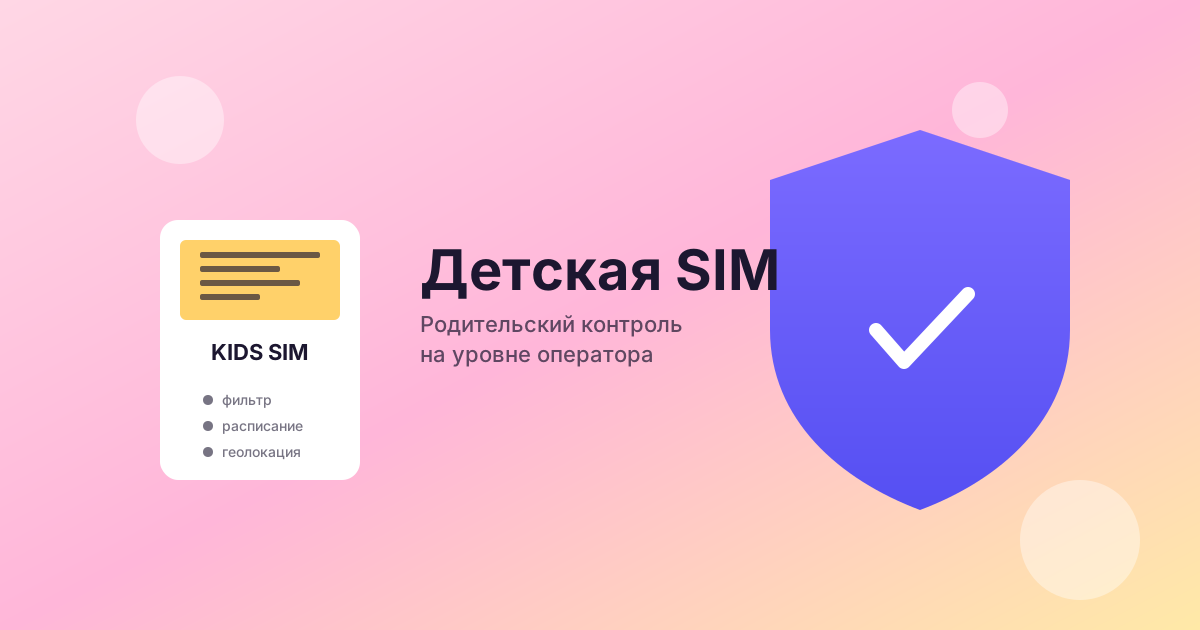
The further mobile and internet technology develops, the deeper it sinks into everyday life. In Kazakhstan today, almost everyone has a connected smartphone within arm's reach. Look around: parents endlessly scroll short videos at full volume, while a child rewatches the same cartoon for the umpteenth time.
Internet on a phone is now the norm at every age. But while an adult is responsible for what they watch and how they use information, the situation with children is different — their access to content needs control and limits. Mobile operators have started offering a new format here: kids' SIM cards with built-in parental controls.
Let's look at what this is, what features it gives you, and how effective it really is. It's not just a tariff — it's a model where part of the management is shifted to the operator level: site access is filtered, app usage can be limited, and the internet can be turned off on a schedule. Even if phone settings change, the basic restrictions stay in place.
Core features
- Filtering automatically blocks categories of sites with unwanted content.
- Usage control lets you limit social networks and games and set time windows.
- Activity monitoring gives parents an overview of which sites and apps are being used.
- Geolocation lets you track where the device is.
It's all managed through a single app.
Where the limits are
Of course, this is not full protection: restrictions can be bypassed via filterless Wi-Fi, a VPN, or by swapping the SIM. A teenager with even basic technical skills will eventually find a way around it. Treating the system as a closed safety net is a mistake.
In practice, these solutions are most justified for younger kids, when basic boundaries and reduced incidental risk matter most. As the child grows older, effectiveness drops fast.
Important: a kids' SIM is not a silver bullet. It's a tool that creates a basic barrier and lowers the chance of exposure to unwanted content — but it does not solve the problem itself. It only delivers results as part of a wider system of upbringing and supervision. Treating it as a substitute for parental attention is wrong.
Takeaway
Kids' SIM cards are an entry-level tool that:
- reduces the chance of accessing unwanted content;
- makes oversight easier for parents;
- shapes the boundaries of internet use.
But they don't replace:
- parenting;
- digital-safety education;
- direct interaction with the child.
In practice, this is a supporting mechanism that only works alongside a parent's own attention and responsible approach.