

Internet for a private house in Kazakhstan: fibre, a 4G/5G router or satellite — what to choose in 2026
Which internet you can realistically connect in a private house or at a dacha: GPON fibre from Kazakhtelecom, almaPLUS and Meganet, ADSL over the phone line, a 4G/5G router and satellite. We compare speed, connection cost and the catches.
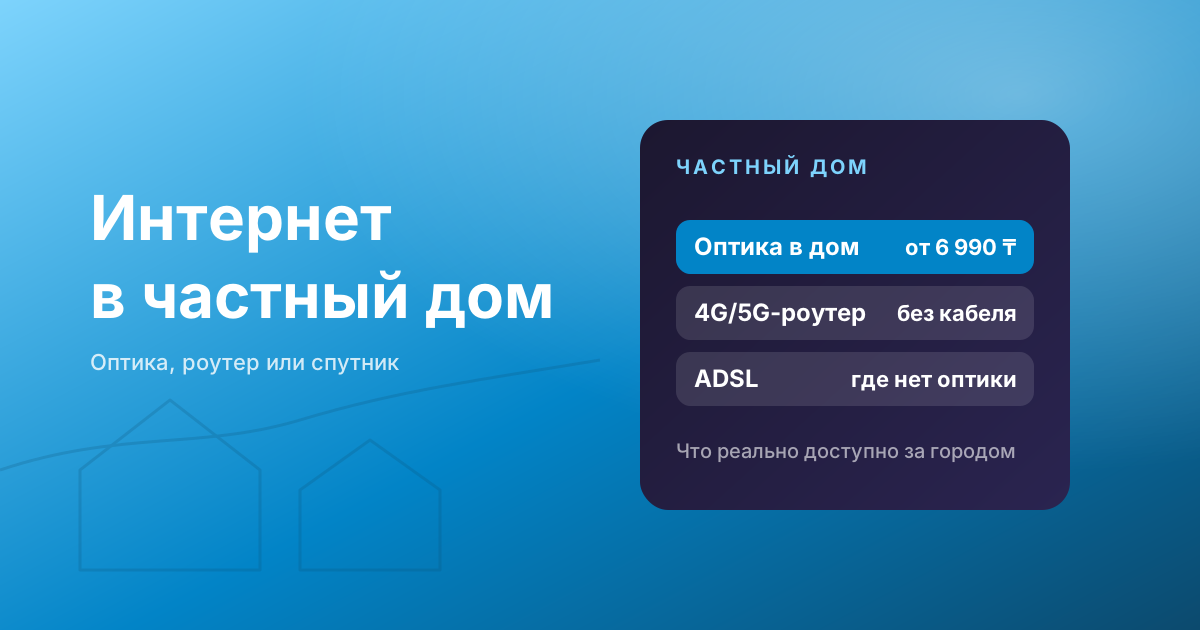
In an apartment block, internet is a matter of picking a provider from a list. In a private house it is different: the cable has to physically reach your plot, and sometimes it simply is not on the street. Here are the four realistic ways to connect a house and the order in which to check them.
Option 1. Fibre to the house (GPON / FTTH)
The best option for speed and stability: fibre is brought into the house and an ONT modem goes on the wall, with a Wi-Fi router plugged into it. Speeds run from 100 to 1000 Mbit/s, latency is stable and the weather does not matter.
Who connects the private sector:
- Kazakhtelecom — the widest FTTH network in the country, including district centres and villages. Standard plans of 100–500 Mbit/s, free installation, the ONT modem is rented.
- almaPLUS — a dedicated "Үйде" line of 150, 350 and 550 Mbit/s for the private sector; at the time of writing installation in the private sector is free.
- Meganet — private-house plans of 400–800 Mbit/s in Almaty, Shymkent and nearby towns; the cable is run overhead without digging up roads.
- Transtelecom, Freedom Telecom — subject to availability in the larger cities.
What to clarify: who pays for the cable from the pole to the house (usually the provider, but for long runs they may ask for a contribution), and whether a router is included — the ONT modem alone often does not broadcast Wi-Fi.
Option 2. ADSL over the phone line
If the house has a landline, you can get internet over the same copper pair. It is the cheapest option — Kazakhtelecom's plans for small settlements start at around 2,200 ₸ a month — but also the slowest: real speed depends on the distance to the exchange and the line quality and rarely exceeds 10–20 Mbit/s.
ADSL makes sense when you need a stable "home" channel for messengers, payments and HD video and there is no fibre on the street yet. It will not do for 4K, gaming or several users.
Option 3. A 4G/5G router
The fastest to set up: a SIM card in a dedicated router and Wi-Fi works today, with no cable and no application. Operators sell unlimited plans for 4G and 5G routers, and the router itself can be rented or bought.
There are limits too:
- speed depends on coverage and how busy the tower is — in the evening it can drop several times over;
- "unlimited" usually comes with a fair-use policy after which speed is throttled;
- latency is higher than fibre, which shows in games and video calls;
- a dacha or a house outside town may need an external antenna.
Still, for a dacha, temporary housing or while waiting for fibre it is the optimal choice. Compare operators' offers in our router internet catalogue.
Option 4. Satellite internet
Satellite works where there is neither cable nor mobile coverage. But it is expensive: the terminal costs hundreds of thousands of tenge, the monthly fee is several times higher than wired, and speed depends on the weather and satellite load. For most homes in Kazakhstan it is a fallback, not the main route — worth considering only after the three options above have been checked.
The order to check
- Check fibre at your address with Kazakhtelecom and the local providers in your city. How to do it is in our step-by-step guide.
- If there is no fibre, find out whether there is a phone line and what ADSL speed is realistic at your address.
- Measure mobile coverage at home: if a phone shows stable 4G/5G and a speed test gives 30+ Mbit/s in the evening, a router will cover your needs.
- Leave a request for fibre anyway: providers build networks by demand, and your street may be in next year's plan.
Comparison table
| Method | Speed | Connection | Stability | Best for |
|---|---|---|---|---|
| GPON/FTTH fibre | 100–1000 Mbit/s | Free or by distance | High | Permanent home |
| ADSL | 1–20 Mbit/s | Needs a phone line | Medium | Basic tasks |
| 4G/5G router | 20–300 Mbit/s | Immediate, no cable | Depends on the tower | Dacha, rentals, waiting for fibre |
| Satellite | 20–150 Mbit/s | Expensive terminal | Depends on the weather | Remote areas |
Bottom line
For a private house the rule is the same as for an apartment: fibre first if it is available, then the compromises. Private-sector plans with free installation, speed and price are collected in the Tandap home internet catalogue — switch on the "Private house" filter to see only the plans that fit.